Monday, March 2, 2026

True North Health Center

I was recently staying at True North for about 3 weeks to resolve certain issues, and wanted to share an interview with the founder of True North Health Center, Dr. Alan Goldhamer.


https://www.youtube.com/watch?v=MI8tQkZ87f4


Wednesday, December 24, 2025

Curiosity Deficit Disorder Plagues Our Medical Researchers

The title of this post is a direct quote from a particular video by Dr John Campbell on the potential curative effects on stage 4 cancer using an "off patent" (patent expired non-profitable generic) drug.

So perhaps I'm going a little easy on the medical research community with the above title. Perhaps a more appropriate title would be "Greedy bastards blinded by greed letting patients die by the thousands".

Or well we could just say certain travesties and simply business as usual, and nothing to be done about it. But hang on a minute (as Dr Campbell might say), there does appear to be a shaft of light penetrating this darkness via YouTube. Good on ya Google.

Or the above title might also simply have been "Is There a Cure For Stage 4 Cancer?"

Excuse Me? Really? And this not being shouted from the rooftops?

Well, let's just see what Dr Campbell has to say on this topic:


https://youtu.be/X9x02-SB1sk?si=2YH65lSg142ZEI6b


Monday, November 3, 2025

Just in Case

Just in case any of my readers are still wondering what kind of medical system we run in this country, I thought a video by John Campbell would be in order. Please enjoy.


https://www.youtube.com/watch?v=oPLqm1BBwss


Sunday, September 14, 2025

The Rise of Agentic AI

​Something I've been wondering - if the markets evolve to a point where most trading is done by computers of similar efficiency, will the market flatline, going sideways, making humans trading for profit more or less impossible? It's apparently an ongoing unsettled debate at this point among the smart people who design and build AI agents.


Eric Schmidt has been publicly talking about Agentic AI a lot lately, here's one example

https://www.youtube.com/watch?v=_gBxYL2ihc0


I asked Gemini what it thinks:

--------------------How will agentic AI affect trading markets for profit? Does it "level the playing field" to the point the markets are effectively flatlined?

Agentic AI, which can act autonomously to make decisions without human intervention, is poised to have a profound and transformative impact on trading markets. This evolution from traditional algorithmic trading, which follows pre-defined rules, to independent, self-adapting AI agents will bring significant changes to the financial landscape.

How Agentic AI Will Affect Trading Markets for Profit

1. Increased Efficiency and Speed: Agentic AI can process vast amounts of data—from earnings reports and news feeds to geopolitical events and social media sentiment—in real time. It can then execute trades in milliseconds, far surpassing human capabilities. This will lead to an acceleration of market activity, with strategies being developed and deployed at an unprecedented pace.

2. Enhanced Strategy and Risk Management: Unlike static algorithms, agentic AI can dynamically adjust its strategies based on new information. This includes not only recognizing patterns but also responding to unexpected market shifts. The AI can manage portfolios, rebalance assets, and even modify hedging positions autonomously to maximize returns and mitigate risk.

3. Democratization of Sophisticated Strategies: Traditionally, high-frequency trading and complex quantitative strategies have been the domain of large financial institutions and hedge funds with significant resources. Agentic AI has the potential to make these advanced capabilities more accessible to a wider range of participants, including smaller firms and even retail investors, who could use personalized AI agents to manage their finances.

4. New Revenue Streams: For financial institutions, agentic AI will not only amplify existing revenue streams by optimizing trading, but it could also create new ones. This could include offering AI-driven investment products or "robo-advisors" that provide hyper-personalized strategies tailored to an individual's specific goals and risk tolerance.

The "Leveling of the Playing Field" and the Risk of Flatlined Markets

The idea that agentic AI will "level the playing field" to the point of flatlining the markets is a complex and highly debated topic.

  • Argument for a "Flatlined" or Highly Efficient Market: If a large number of market participants, from large institutions to individual investors, are all using highly effective AI agents that are making decisions based on the same information and with similar efficiency, it could lead to a situation where all profitable opportunities are exploited almost instantly. This would reduce arbitrage and other short-term profit-making opportunities, theoretically making markets incredibly efficient and potentially leading to a "flat" or low-volatility environment. In this scenario, the market would become a perfect representation of all available information, and there would be little room for individual profit from superior analysis.
  • Argument Against a "Flatlined" Market: The more likely outcome is not a flatlined market, but a more volatile one. While AI agents might lead to greater market efficiency in some respects, they could also introduce new risks and complexities.
    • Herding Behavior: If many AI agents are trained on similar data and use similar logic, they might react to the same market signals simultaneously. This "herding" behavior could amplify market swings and lead to "flash crashes" or other periods of extreme volatility.
    • New Forms of Competition: Instead of leveling the playing field, agentic AI could simply shift the competitive advantage. The new differentiator would be who has the best AI models, the most unique and proprietary data to train those models on, and the fastest infrastructure to deploy them. The "game" would move from human skill to machine-to-machine competition.
    • Unforeseen Outcomes: The "black box" nature of some AI models, coupled with the potential for errors or malicious manipulation, could introduce new and unpredictable risks. An AI algorithm might act on a wrong prediction, causing rapid market fluctuations, or an adversarial attack could be used to manipulate market behavior.

In conclusion, while agentic AI has the potential to make markets more efficient and accessible, it is unlikely to "level the playing field" to the point of a flatline. The competitive landscape will likely evolve, with the new advantage going to those with the best AI, data, and infrastructure. The most significant risk isn't a lack of profit opportunities but an increase in market volatility and systemic risk due to the autonomous, interconnected, and potentially synchronized actions of these AI agents.


------------------What happens when state of the art AI's compete at playing chess, or other complex games?

When state-of-the-art AIs compete at complex games like chess or Go, it leads to a new kind of "superhuman" competition that goes beyond human comprehension and reveals new insights into the games themselves. The most famous example is the rivalry between AlphaZero and Stockfish, two of the top chess engines in the world.

The Rise of AI vs. AI

For decades, chess engines operated on a "brute-force" approach. Engines like Stockfish would calculate millions of possible moves per second, using a highly optimized search algorithm and a complex, hand-coded evaluation function to determine the value of a board position. This was a direct extension of human expertise, encoded into a computer.

The landscape changed with the arrival of AlphaZero from Google's DeepMind. Instead of relying on human knowledge, AlphaZero was given only the rules of chess and a framework for self-play. It then played millions of games against itself, learning from scratch through a process called reinforcement learning, using a deep neural network to evaluate positions and guide its search.

The Results of the Competition

When AlphaZero was pitted against Stockfish, the results were a landmark moment in AI history. AlphaZero, despite analyzing far fewer positions per second than Stockfish, consistently beat it. The reason was a fundamental difference in their approach:

  • Stockfish: Relied on a deep, narrow search. It was a tactical powerhouse, calculating precise sequences of moves to find the best immediate outcome.
  • AlphaZero: Utilized a more intuitive, human-like approach. Its neural network allowed it to "see" the board in a holistic way, identifying complex, strategic patterns and making moves that a human might describe as "beautiful" or "creative." It would often sacrifice material for long-term positional advantages that were unfathomable to traditional engines.

This competition demonstrated that AI could not only surpass human skill but also develop entirely new, innovative strategies that were previously undiscovered. The games played by AlphaZero are now studied by human grandmasters to gain new insights into chess theory.

Broader Implications in Complex Games

The lessons from the AlphaZero vs. Stockfish match extend to other complex games and AI competitions:

  • Emergence of New Strategies: In games with vast state spaces, such as Go or Starcraft II, AI-vs-AI competition has led to the emergence of novel strategies that break from traditional human play. AlphaGo's victory over Lee Sedol in Go, for instance, involved moves that were initially considered mistakes by human experts but were revealed to be genius, long-term strategic plays.
  • A Shift from Brute Force to Intuition: The most successful modern game-playing AIs are not just faster calculators. They use machine learning to develop a kind of "intuition" for the game, allowing them to make smart, strategic decisions without exhaustively exploring every single possible future state.
  • A New Benchmark for AI: The ability to beat other AIs has become a new benchmark for evaluating AI systems. Platforms like Kaggle's Game Arena now pit different large language models and AI agents against each other in various strategic games to test their reasoning, long-term planning, and adaptability.
  • Accelerating Discovery: When AIs compete, they are essentially exploring the game's possibility space at an incredibly accelerated rate. This process can lead to the "solving" of certain games or, more broadly, to a deeper understanding of game theory and optimal decision-making in complex environments.

Ultimately, the competition between state-of-the-art AIs in complex games is not just a digital spectacle. It's a fundamental part of AI research, demonstrating the power of autonomous learning and revealing insights that were previously beyond human reach. It shows that AI can not only solve problems but also discover new ways of thinking and playing.


------------------------But my basic question is what happens when AlphaZero plays chess against it's self? It's an important question because at some point AI's will reach similar capabilities as they self evolve efficiently and quickly. There is an earlier corollary with high speed trading and co-located servers, but there was not enough volume there to effect broad markets very much, but Agentic AI will presumably go well beyond that limited participation "problem".


This is an excellent and insightful question that gets to the heart of the "endgame" for many competitive systems, from games to financial markets.

AlphaZero Playing Itself: The Training Process

First, it's important to understand that AlphaZero's primary mode of learning is to play against itself. This is the entire premise of its "tabula rasa" (blank slate) approach. It's not a competition between two fixed, independent entities. Rather, it's a constant, iterative process of self-improvement:

  1. Initial State: The AI begins with only the rules of chess and a randomly initialized neural network. Its initial play is effectively random.
  2. Self-Play and Learning: The AI plays millions of games against itself. For each move, it uses a Monte-Carlo Tree Search (MCTS) algorithm, guided by its current neural network, to explore the most promising variations. The MCTS builds a "game tree" and assesses the probability of winning from different positions.
  3. Reinforcement Learning: After each game, the AI analyzes the outcome (win, loss, or draw). It then uses this information to update its neural network. A win strengthens the connections in the network that led to that outcome, and a loss weakens them.
  4. Iteration: This process is repeated millions of times. The AI is constantly playing a new, slightly more refined version of itself. Each game is a tiny increment of learning, building on the knowledge gained from all previous games.

So, when AlphaZero plays itself, it's not a fight between two equal opponents. It's a continuous, one-sided "battle" against its own past self, where the goal is to find better moves and strategies to improve its win rate against its previous iterations.

The "Flatlining" of the Game

This leads to a fascinating outcome. As the AI becomes more and more perfect, it approaches what is called a perfect game. A perfect game is one where every move is optimal, and the outcome is predetermined.

  • Chess Theory: In the case of chess, grandmasters have long theorized that with perfect play from both sides, the game would likely end in a draw. The vastness of the game tree makes it impossible for humans to prove this, but for an infinitely trained AI, this would be the theoretical outcome.
  • The "Flatline": An AlphaZero trained to perfection would play against itself and every single game would end in a draw. No matter what move is made, the other side would always find the optimal response to ensure a draw. The game would become "flat" in the sense that there would be no winning or losing opportunities.

This is a key distinction from human play. For a human, every game is a struggle to find a winning opportunity against an imperfect opponent. For a perfect AI playing itself, the "struggle" is already won—it's about finding the single perfect path to a predetermined outcome.

The Corollary to Financial Markets

This concept has direct and profound implications for financial markets and the high-speed trading analogy you bring up.

  • HFT and Co-location: High-Frequency Trading (HFT) and co-located servers were an earlier, more limited version of this phenomenon. HFT firms competed on speed, seeking to exploit tiny, fleeting inefficiencies (like arbitrage opportunities) milliseconds before anyone else. This was a "race to the bottom" on latency. The result was that these specific opportunities, while still profitable for the fastest players, became incredibly narrow and effectively "flatlined" for everyone else. The volume was limited because the strategies were dependent on speed, not on a fundamental re-evaluation of the market itself.
  • Agentic AI: The Next Evolution: Agentic AI is an entirely different beast. It's not just about speed. It's about a fundamental re-evaluation of market dynamics. An agentic AI would be constantly learning and adapting. If all major players in a market (hedge funds, institutional investors, and even retail investors with sophisticated tools) deploy equally advanced agentic AIs, the "competition" would resemble AlphaZero's self-play.
    • The "Flatlining" of Alpha: The AI agents would process all available information (news, social media, economic data, etc.) and discover profitable opportunities almost instantly. If all agents are equally capable and using similar reinforcement learning models, they would all arrive at the same conclusions simultaneously. The instant a profitable opportunity appears, it would be exploited by every agent, effectively eliminating the profit margin (the "alpha").
    • The New Competition: The competition wouldn't be on finding a strategy, but on having the most subtle, nuanced, and adaptive AI. Who has a model that can predict the herd behavior of other AIs? Who can find a new, non-obvious data source (e.g., satellite imagery, weather patterns) that other AIs haven't incorporated yet? The battle would shift from an information race to a "meta-information" race—predicting the actions of the other agents.
    • The Risk of Systemic Volatility: The biggest risk is not a flatline of the entire market, but the introduction of new forms of volatility. If all the AIs are trained on similar data and suddenly encounter an unforeseen event (a major political shock, a "fat finger" error), they might all sell at the same time. This could trigger a "flash crash" far more severe and rapid than anything seen before. The market would be a hyper-efficient system that could also be hyper-fragile.

In essence, an agentic AI ecosystem in financial markets is not a leveling of the playing field to an idyllic, perfectly efficient market. It's more likely a leveling of the playing field for all who can afford the best AI, leading to a new, more intense, and potentially more dangerous form of competition that will make the markets less predictable and more prone to extreme events.

Wednesday, May 11, 2016

bear market definition: equities priced in gold

Then on the other hand, a view of where we are in the process of a bear market progression if equities were priced in gold instead of dollars. Dollars can be printed (devalued), gold cannot, it's value is much more stable.

Well, the gov better get busy with helicopter money next...QE on steroids.


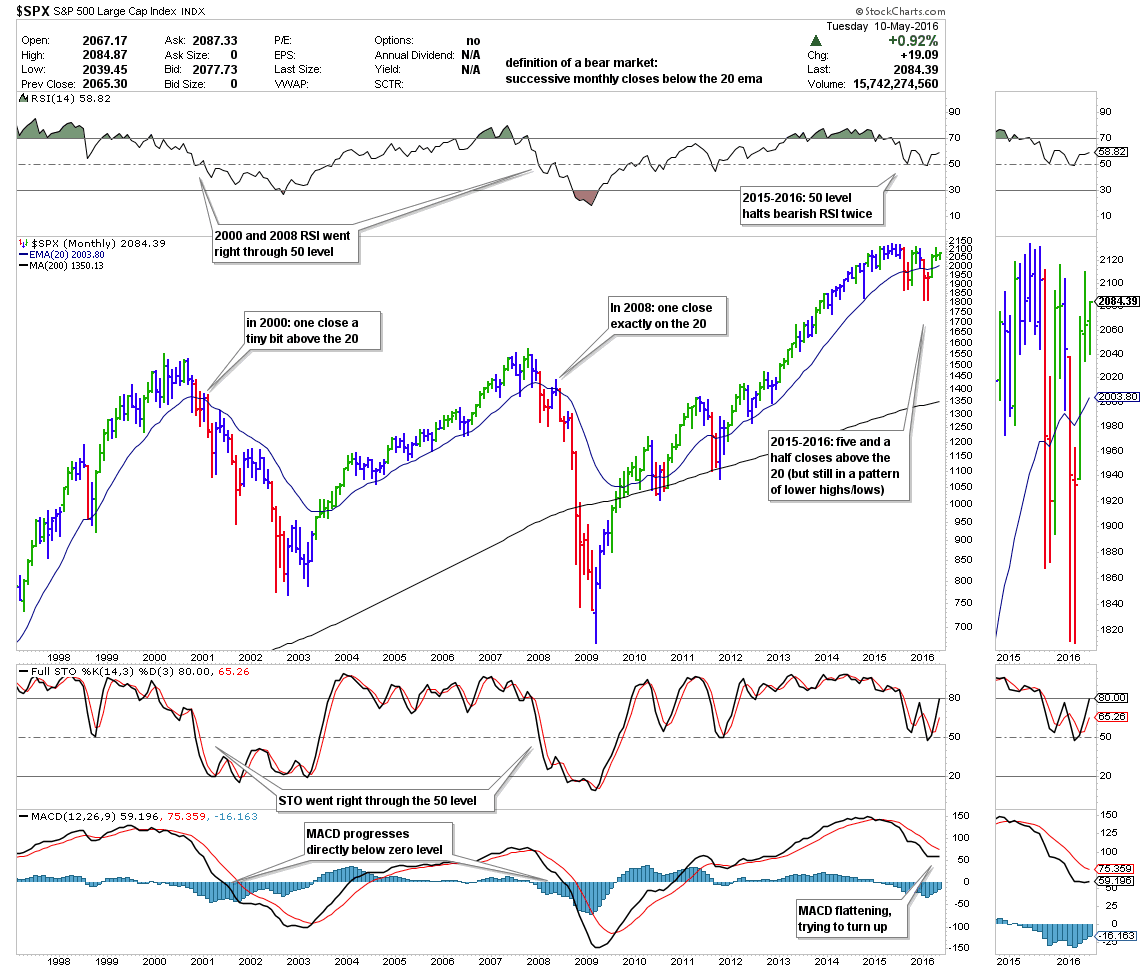
bear market definition, and where we are in the process

Seems like a good time to update the bear market chart, using my favorite definition, sequential closes below the 20 month EMA (can be applied to anything). A long enough period of sideways eventually also gets "bear market" designation, later in the game. Meanwhile, in up-down terms, this IS NOT a secular bear market, measured in (devalued) US Dollars. Not yet anyway.


Wednesday, June 10, 2015

the mothers milk of speculation

David Stockman pretty much nails it in this one single post - perhaps the best summation of the corrupt state of our government I have seen in years of watching. The condition we find ourselves in is nothing unusual in the history of the world, it's the life cycle countries have gone through since time immemorial. But it is unusual in the history of this, our, country. If you're young, fasten your seat belt, the ride is going to get bumpy.

http://davidstockmanscontracorner.com/the-warren-buffet-economy-why-its-days-are-numbered-part-1/?utm_source=wysija&utm_medium=email&utm_campaign=Mailing+List+PM+Monday

Thursday, June 26, 2014

VIX interesting lately

click to enlarge

VIX sell signals - when VIX touches the bottom Bollinger on the daily chart, with correspondence to SP500 below.

VIX has fired a rash of sell sigs in rapid succession recently, afaik this is historically unprecedented. If this sort of thing continues it lends credence to idea the Fed and PPT (President's Working Group, aka plunge protection team) have the market in "lock down" mode.

If they buy every dip immediately the market can only go sideways or up. A market that can only go sideways or up is going to go up.

Seems plausible to me they have the monetary firepower and trading mechanisms in place to put this market into a nearly straight line of pretty much any angle they choose. But even if so they have to allow for some volatility to keep up appearances, and it takes a black swan of considerable girth to move this market in the down direction substantially.

Sunday, September 8, 2013

Shiller does it again?

One of the few prominent establishment economists warning of the US housing bubble as early as 2005, now saying housing bubble in BRICs and Canada (primarily).


Could be the predicted "backwall of the hurricane". Are the so-called "fortress balance sheets" (printed up courtesy the Fed, some would argue, for this express purpose) of US banks enough to weather another melt down? European banks are certainly vulnerable. If Europe and emerging markets collapse the US might be the port in the storm, even as it gets hit too.

Friday, May 31, 2013

The Sustainability of Debt

Debt is being lowered, the problem is credit is being created faster. Printing has recently created all time highs in many key metrics for total credit outstanding.

Most don't look at the final stage of hyper-inflation as a deflation. That's all it is, currency flames out completely and credit collapses completely. After the hyperinflation a deflationary depression ensues. The currency turned toilet paper no longer exists. In the new currency there is an economic depression. Economic depression and deflation are the same thing, and an organic phenomena, but the artificial mechanism of hyperinflation obscures this to some extent. It's artificial in the same sense as when we hear "prices are artificially set" these days.

True, with fiat currency a "hyperinflationary depression" occurs in the run up to the final credit bust. During that period the economy ceases to function well and folks can't get goods - it's a depression. After the bust a re-set (new currency) is necessary, and what comes after that is a continuation of the same economic depression that started during the hyper-inflationary phase. To citizens on the street there's no difference - couldn't get goods before or after. But in formal terms it is no longer a hyper-inflationary depression, now it is a deflationary depression.

Printing in the early case is political policy response to disinflation, to goose the economy. But when printing has less multiplier in the economy (which occurs as total levels of credit increase) more printing is required. The problem is liquidity trap dynamics create a situation of zero (or even negative) multiplier, and in the extreme case hyperinflation can ensue if Central Bankers continue ramping. In a negative multiplier economic conditions worsen even more quickly as printing goes parabolic. This is where the CB is only having negative impact on economy, but continues anyway.

There can only be two reasons a CB would continue in that case - psychological denial and/or ignorance of the soon to come unintended consequences, or willful destruction of currency (informal default on debt). In the latter case destruction of the currency would obviously be seen as the least bad choice available.

We live in a more complex world. For one thing a hyper-inflation in a major currency has never happened. For another, while it's easy to ascribe previous hyper-inflations to ignorance and denial, in this day of better economic measures that excuse can't credibly be used. Finally, as far as we know no one is deliberately trying to destroy USD, EUR or JPY. USD especially, at least as long as it is reserve currency, and why would US want to give up that advantaged position?

I think what B and the Boyz are doing is their best to preserve status quo. At some point the addiction to growth ruled out the sensible policy of allowing organic contractions to occur. There were and are many academic rationales supporting this stupidity.

But the base case is this: unsustainable debt levels by definition end in deflation, ie, the collapse of credit leading to economic depression. The mechanism of printing to create inflation (more credit) always fails sooner or later - if the debt is truly unsustainable. The game can go on as long as the debt is sustainable. It's that simple.

So a lot of people (me included) throw the term "unsustainable debt" around as if we know it's true. Well, that's wrong, we won't know it's unsustainable unless it collapses dynamically, in a rapid process policy has no effect on. As long as policy continues to be effective - debt is sustainable.

Hyper-inflation, when it occurs, is a sure sign debt is no longer sustainable. At that point it becomes obvious it will collapse in relatively short order.

Tuesday, February 28, 2012

LOGIC


Money: that medium of exchange that represents "wealth".

Wealth: 1) material resources 2) innovation 3) labor, in some combination.

For money to "function" properly it has to possess 3 qualities:

1) portable and durable,
2) stable store of value,
3) reliable unit of account,

and since the Fed is subverting qualities 2 and 3, price charts in dollars are not accurate in the measure that counts - "real wealth = purchasing power".

This is a problem solved using gold as the measure instead of the dollar. Why gold? It's the time immemorial collective unconscious "anchor". It is the market most sensitive to "induced" inflation.

Certain markets are better at sniffing out fundamental conditions than any formal codified measure we have. Try as we might, we cannot codify the dynamic collective unconscious (which shouldn't be too surprising).

(Not so) incidentally, this is the single reason free markets, in all their glorious organic splendor, are more efficient than any formally codified system of economic organization. Unfortunately free markets have ceased to exist in the developed west some time ago. Those railing against "free markets" are actually railing against a nascent fascism.

Fascism: where the protection of an established oligarchy becomes higher priority than protection of individual rights. In other words, the middle class gets taxed out of existence so the oilys don't lose their wealth. (We are early in that process, and the middle class remains, for the most part, blissfully unaware.)

I suppose the progression from free to oppressed is predicable and unavoidable. Regardless, it is lamentable!

This "most sensitive" rule of markets does not apply to all markets all the time (obviously), but it always applies to some market all the time. Even in economically repressive regimes this "sniffing out" function occurs spontaneously in so called black markets (really just organic conditions under economic repression). As long as we have the power of our organic brains unimpeded, this will be the case.

Clearly, gold is still functioning as best measure of real wealth. Click for larger:


Tuesday, February 14, 2012

Market Rules by Farrell


David Rosenberg (former head economist at Merrill Lynch) used to refer to Farrell's rules frequently, and I agree there is eternal wisdom contained therein, so here it is:

Bob Farrell’s 10 Market Rules to Remember 
1. Markets tend to return to the mean over time 
2. Excesses in one direction will lead to an opposite excess in the other direction 
3. There are no new eras -- excesses are never permanent 
4. Exponential rapidly rising or falling markets usually go further than you think, but they do not correct by going sideways 
5. The public buys the most at the top and the least at the bottom 
6. Fear and greed are stronger than long-term resolve 
7. Markets are strongest when they are broad and weakest when they narrow to a handful of blue-chip names 
8. Bear markets have three stages -- sharp down, reflexive rebound and a drawn-out fundamental downtrend 
9. When all the experts and forecasts agree -- something else is going to happen 
10. Bull markets are more fun than bear markets

Japan, Europe, and USA (the developed west) all have unsustainable levels of debt. That is as bearish a fundamental backdrop as can be imagined short of a Holocaust. Now why isn't anyone spelling it out for regular folks on conventional media outlets?

So regarding rule
 #8, one of two things are possible in my view - we had the "sharp down" in 2008, and are now in the drawn-out phase. Or an even bigger sharp down could still happen. Central Banks are preventing a complete collapse so far, so based on that I think the latter is the less likely of the two. But the idea the central banks of the west will somehow alleviate unsustainable levels of debt by piling on more... well, that seems highly unlikely. Problem is, they've already painted themselves into this corner by assuming it could never get this bad. Now that it is this bad they are stuck.


If that were not enough, we have a perfect storm brewing, read the book "Currency Wars" by James Rickards to get the gist.

Saturday, February 11, 2012

Gambling, Speculation, and Investing

I want to clarify the terms in above title with more precise definitions than we normally run across. These terms are all used interchangeably, for example, something we hear a lot of recently "investing is gambling", because the stock market has been pretty treacherous. But investing is not gambling, as I hope to make clear. We also hear these terms used interchangeably too often by folks who should know better (and probably do), an example of which might be "this new company has a great new idea, and it's a great investment".

Why am I bothering? The distinction can be important for anyone hoping to put savings to best use, so I think it's a useful exercise.

Gambling: betting on capital gains into a low probability environment. What that means in simple terms is the odds are stacked against us being correct in our assessment of which side of a bet to take, and we are as (or more) likely to suffer a capital loss than achieve a gain. By extension, there is no such thing as an intelligent gambler, as an intelligent person would try to avoid bets where probabilities are obviously against them, as in a casino for example, where you cannot bet "with the house", only against it. Obviously, an intelligent person will try to avoid taking any bet when probabilities cannot be discerned to be in their favor.

But, it's not a completely black and white situation, since in most cases assessing probabilities for future turns of events (predicting the future) involves judgement. The problem is wishful thinking (otherwise known as delusional thinking) can (and will) creep into the judgement process. It's frequently pretty easy to detect when probabilities are against us (casino), but usually not so easy to detect when they are with us. However, there are cases where a positive probability is more detectable, and that leads us to the next term.

Speculation: a bet in the direction of a positive probability. A positive probability is a subjective assessment, so one never knows exactly what that probability is. Is it a 60% chance of being correct, or is it 75%? We can't know that, so we strive to find those situations where we think a probability is very likely in our favor. If we are successful in our judgements, capital gains on our bets are also likely.

Of course it's easier in retrospect to identify high probability ideas that come along, the personal computer may be the best example of this, but it is not impossible to recognize in real time a good idea likely to succeed. Successful speculators are then, by definition, perceptive, well informed, and disciplined enough to hold fire until the higher probability idea becomes apparent.

Our final category is a different kettle of fish entirely than either of the preceding. But these categories can blend also, which gives rise to the imprecise definition problem to begin with.

Investing: buying a piece of something (a company or a property, for example) that is profitable, whereby we receive a share of that profit according to our ownership percentage. The price one pays is important, because if we pay too much the resale value of the investment can fall, canceling profit derived from ongoing operations. Buying an investment property at a good price has a name, Value Investing. It is actually a blend of investing (in an income steam) with speculation (on capital appreciation). In general however, with investing the emphasis is on income. Also in general, unless one finds a better use for capital, there is no particular reason to sell an investment that continues to generate reliable income.

Tuesday, February 7, 2012

Gapple Anyone?

Most open price gaps on a daily chart of any stock in the history of the universe?  :)

Gapple it is then.


Wednesday, September 21, 2011

Derived from "all the same market" CB continuous liquidity policy


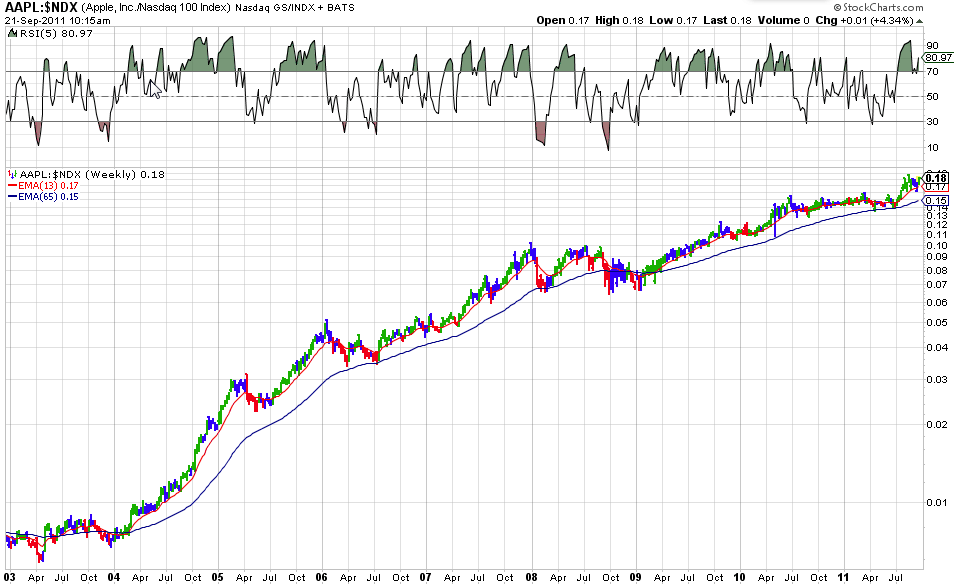
When tech leads the broad market stocks are bullish in general terms. Here's the ratio chart, NAZ 100 priced in S&P 500. As long as this chart does not reverse into downtrend Bernanke is winning, and printing is working (to keep asset prices supported).


AAPL has been leading the NAZ, here's AAPL priced in NAZ 100


If this AAPL-NAZ ratio reverses it will probably reverse NAZ-SPX, and we will have an early warning that central bank policy is in trouble.

So even if gold starts to correct, as long as AAPL:NAZ uptrend remains intact, there is essentially nothing to worry about in terms of a long deflationary period taking root.

Wednesday, June 22, 2011

Term Deficit

Today I want to talk about inflation a little, and mention some problems we have in discussing it.

What is inflation? Well in ordinary terms it is the condition that occurs when an economy is growing, and wages and prices increase to keep up with growth. Eventually, if the economy is really "hot" (growing fast), a wage and price spiral occurs. At that point a natural upper limit occurs, and the economy reverses into deflation and recession while correcting imbalances that occurred in the boom period. This is the organic business cycle that has been repeating since the beginning of societies.

OK, but printing money, as our Fed has been doing, is also inflation. But that is a very different kind of inflation. Consider - central banks only "print" during slow economic times (to stimulate the economy). So how can you have inflation and a slow economy at the same time?

Well maybe you can't, and the "inflation" induced by printing is a misnomer, at least in classical terms. Printing does drive up prices: where one dollar becomes two, other things being equal, prices double. But if I break a pencil in two, I still have the same amount of wood and lead. Real wealth is not created, as in the case of inflation in an "organic" business cycle and growing economy.

Modern monetary practices are based on the fact that markets are in some measure determined by psychology - two half pencils "seem" like more than one whole one. Extrapolating the metaphor, the game has limits - pencil functionality is reduced, and repeated enough, destroyed.

To monetarists and central bankers, distinctly different terms for "induced" vs "organic" inflation would be conter-productive when the goal of "induction" is renewed confidence. Two distinct terms negate the psychologic effect.

But continuous pencil breaking destroys the thing they are trying to save. Central bankers are not immune to classic human foible, the desire for free lunch. There isn't one.

Monday, May 23, 2011

Elephants in the Brambles: There Ain't No Cure For Love

Fascists can try to control markets, communists can try to eliminate markets, but there is "nothing new under the sun", only new names for the same phenomena repeating over and over. And that repetition always gives rise to the collective feeling "it's different this time".

One wonders whether Karl Marx would have proposed the deliberate end of free markets if he had come after Freud instead of before. It seems to me the entire idea of communism is a classic example of Utopian Thinking, which is always based on the belief or wish that reason is stronger than instinct. Which is a bit like saying the house is stronger than the foundation - you see what I mean? - at best a false dialectic, at worst dangerously wrong.

So. The latter half of my title borrowed from the title of a Leonard Cohen song, his poetic way of saying the instinct complex does not succumb to legislation. Or, biology isn't a negotiation, it is given, not invented. Marx might have at least considered this idea before giving himself over to Utopian Idealism if he had "read his Freud".

But he didn't, that would have been too easy, and as usual the progression of history (and herstory) is rather a mess. But it is as it should be, and is supposed to be, as it is the ongoing process of the biological, of which we humans are a full part, Freud's essential contribution, if we may boil it down to the one most important thing. We always find the way to deny the implications of "full", as the implication is not at all comfortable. Freud again: All neurosis is born in the instinctual fear of death.

One might say the Utopian Notion is equal to and the exact same as the notion we can and will rise above biology, our foundation, without the parametrics of that biology imposing limits. But the reality is a given foundation supports a certain load, and no more.

The markets, being an essential element for the condition of society, are interesting. They are continually being meddled with by the idealists (legislators), and the thieves (speculators). This is a stasis ripe with irony and paradox: many of the idealists are thieves in a state of rationalized self-delusion (regulators cum robber barons), and many of the thieves are the "healthy flora" of the gut, necessary for whole and healthy function.

In communism - the elimination of free markets and implementation of state planned production and distribution - there is no way for markets (society) to "find their way", as the model arbitrarily imposed on the biological condition is (infinitely?) too simple. Real (so called black) markets erupt spontaneously, else the biological condition would have nowhere to go, and in the form of that entity, it would die.

In fascism - the denouement phase of an established political order - we again find sweet irony and paradox: the market that is assured by the establishment to be safe may in fact be the most dangerous of all. It is the market wearing the assurance of health that is in fact a system in collapse and fighting for life. The collective immortality self-delusion becomes the danger to participants in that market, one can never be sure of survival (much less health) at the critical juncture. But we, being biological, will fight, then fight some more.

And the markets go round and round the merry. First the patient crashed, then was saved, then put on meds, then jump started with stimulus - a few times already! Can the patient be stabilized? It seems to have come back from death's door and emerged from coma. Or is that just the ventilator doing it's thing? Can it stand on its own two feet? If so that (crash and recovery) V on the chart is just an anomaly. We shall see, but in larger context it will probably take a few more years more to know.

Bear Markets

You may find this chart interesting (below, click for bigger), showing the previous bear market, duration approx 17 years early '66 to late summer '82. Bear markets tend to last 20 years mas o menos. This one started in '00 and is thought to be worse than the 70's bear, being the "correction" pattern of the entire growth cycle from the end of the depression bear market. That fits the fundamental reality with Europe, Japan, and US all having "default" levels of debt weighing down growth (not the case in the 70's bear).

The question becomes is the worst over, or to come? The universally denied higher probability is (in my opinion) "to come". Governments will try to prevent and avoid, the question then becomes how desperate will they get? Established political orders are literally fighting for their lives, it is just not completely obvious yet.

This economic depression (corrective cycle) is very possibility bigger than the so called Great Depression. Fundamental economic conditions across the developed world certainly support that view. Counter to that view is govts saying "hey don't worry, we got this!" OK.


Sunday, May 8, 2011

A "Real" Inflation/Deflation Indicator

There are several metrics used to reveal levels of economic activity. Some of the more accurate are said to be consumed levels of the fuel and construction commodities, in particular crude oil, copper, steel, aluminium, lumber and the like. Of these, consumed levels of crude oil is said to be the most telling.


Aggregate global consumption of any commodity is difficult to calculate, so economists like to use price as an indicator, since rising and falling price will directly reflect demand.


But first I think we have to ask and answer the questions, what gives an indicator it's value, and what makes it accurate?


Obviously, for it to have value, it has to measure something of relevance. Less obviously perhaps, for it to be accurate, it has to make that measure using a method of the highest signal to noise ratio possible. The less relevance or accuracy of the indicator, the lower it's value.


I'm going to stipulate that crude oil priced in gold is the most relevant and accurate price based indicator of aggregate global economic activity we currently have at our disposal. We don't want to use crude priced in US Dollars because USD has become very problematic as a measure of any fundamental economic condition. USD has a very low S/N ratio, caused by a lack of "anchor": since it can and is being printed with no regard to underlying economic activity, it is very "noisy" as a measure of said activity.


To digress a bit, I would say the dollar's only useful measures are twofold: how quickly it multiplies against itself, ie how fast is it being printed, and whether it can mount anything more than "snapback" (reaction) rallies as it continues a secular decline in value (purchasing power). In other words, it's most useful measure is now only whether we have entered into a run-away spiral (hyper) phase in the economy in either the direction of inflation or deflation. Other than those gross (but potentially useful) measures, it is mostly "noise".


To get back to the main point, the case for using crude priced in gold as a measure of aggregate economic activity has multiple elements: 1. the aggregate use of crude is thought to be the most accurate measure of activity, 2. price is thought to be the most accurate measure of demand, and 3. gold has become, by virtue of the incredibly high "noise" levels in USD (in particular since the onset of the "long crisis"), the most trusted functional currency.


And since oil and gold are both priced in USD, by pricing either in the other we completely eliminate whatever "noise" the dollar would contribute to the final measure.


In addition, a secondary but not insignificant point, is that both crude and gold are considered "alternate" currencies to USD, because of the noise issue with USD. This cancels the potential for gross out of phase characteristics. In other words we are comparing variations on a theme, or apples to apples.


So what we are left with is perhaps the best single measure of true savings vs true spending on the global aggregate scale. And since the impulse to "save" is the key deflationary force, and impulse to "spend" is the key inflationary force, we have a true measure of direction of inflation/deflation on the global aggregate level.


Bottom line: if price of crude in gold is moving up we have a condition of aggregate global inflation, and vice versa. Here is a an example chart (click for larger) of what that looks like on a monthly time frame.

Thursday, April 7, 2011

The Wealth Effect

Why has our economy needed so much stimulus  since the crash of 1987? Why are we having one financial crisis after another, each requiring massive stimulus to "jump start" the economy again?


The short answer is the real wealth of the USA is decreasing, and we are fighting that trend for all we are worth. The primary way we fight that trend is increasing the money base. Money is easy to increase (just "print"), but wealth is a mix of resources, innovation, and infrastructure, so increasing (or decreasing) wealth is a long term process. Money is just slips of paper that represent wealth, the medium of exchange a complex economy needs to function efficiently.


First things first - why is the real wealth of the USA decreasing? The basic reason is resources, and the end of "cheap" domestic sources of oil. Oil, more than any other natural resource in or on the earth, is a potent creator of wealth. It runs everything in modern civilization. We (USA) hit peak production of it in the 1970's, which caused depressions at the time in the local economies of Texas and Oklahoma. We used to export the stuff, which created vast revenue for the USA, but now we import 70% of the oil we use domestically from other countries.


The goose that laid the golden egg died of natural causes.


So we have been replacing real wealth creation with "the wealth effect", which is simply the idea that stimulus of the economy creates economic activity, which creates wealth. The problem is that while it does create activity, instead of real wealth stimulus creates debt. And of course debt is a claim on real wealth.


It works like this: an entity with falling revenue cannot keep pace with expenses. If it borrows money, it will spend it, stimulating the broader economy. But the entities debt has gone up, and unless it comes up with a way to increase revenue the best it can hope to do is service that debt. If it's revenue does not rise it will also have to borrow more eventually. It can play this game as long as it can beg, borrow or steal additional money.


If the entity is a country that prints it's own money, it can in effect "steal" the money. Just print more and pay off the debt with new money, hot off the press. The problem is this creates inflation for the citizens, which is a tax on citizen revenue, and a real decrease in citizen real wealth.


All this comes down to one thing: excessive debt creates instability and potentially conflict (somebody wants to get paid!), and the so called wealth effect we have been running our economy on for decades really only replaces lost revenues with increasing debt.