Could be the predicted "backwall of the hurricane". Are the so-called "fortress balance sheets" (printed up courtesy the Fed, some would argue, for this express purpose) of US banks enough to weather another melt down? European banks are certainly vulnerable. If Europe and emerging markets collapse the US might be the port in the storm, even as it gets hit too.
Sunday, September 8, 2013
Shiller does it again?
One of the few prominent establishment economists warning of the US housing bubble as early as 2005, now saying housing bubble in BRICs and Canada (primarily).

Friday, May 31, 2013
The Sustainability of Debt
Debt is being lowered, the problem is credit is being created faster. Printing has recently created all time highs in many key metrics for total credit outstanding.
Most don't look at the final stage of hyper-inflation as a deflation. That's all it is, currency flames out completely and credit collapses completely. After the hyperinflation a deflationary depression ensues. The currency turned toilet paper no longer exists. In the new currency there is an economic depression. Economic depression and deflation are the same thing, and an organic phenomena, but the artificial mechanism of hyperinflation obscures this to some extent. It's artificial in the same sense as when we hear "prices are artificially set" these days.
True, with fiat currency a "hyperinflationary depression" occurs in the run up to the final credit bust. During that period the economy ceases to function well and folks can't get goods - it's a depression. After the bust a re-set (new currency) is necessary, and what comes after that is a continuation of the same economic depression that started during the hyper-inflationary phase. To citizens on the street there's no difference - couldn't get goods before or after. But in formal terms it is no longer a hyper-inflationary depression, now it is a deflationary depression.
Printing in the early case is political policy response to disinflation, to goose the economy. But when printing has less multiplier in the economy (which occurs as total levels of credit increase) more printing is required. The problem is liquidity trap dynamics create a situation of zero (or even negative) multiplier, and in the extreme case hyperinflation can ensue if Central Bankers continue ramping. In a negative multiplier economic conditions worsen even more quickly as printing goes parabolic. This is where the CB is only having negative impact on economy, but continues anyway.
There can only be two reasons a CB would continue in that case - psychological denial and/or ignorance of the soon to come unintended consequences, or willful destruction of currency (informal default on debt). In the latter case destruction of the currency would obviously be seen as the least bad choice available.
We live in a more complex world. For one thing a hyper-inflation in a major currency has never happened. For another, while it's easy to ascribe previous hyper-inflations to ignorance and denial, in this day of better economic measures that excuse can't credibly be used. Finally, as far as we know no one is deliberately trying to destroy USD, EUR or JPY. USD especially, at least as long as it is reserve currency, and why would US want to give up that advantaged position?
I think what B and the Boyz are doing is their best to preserve status quo. At some point the addiction to growth ruled out the sensible policy of allowing organic contractions to occur. There were and are many academic rationales supporting this stupidity.
But the base case is this: unsustainable debt levels by definition end in deflation, ie, the collapse of credit leading to economic depression. The mechanism of printing to create inflation (more credit) always fails sooner or later - if the debt is truly unsustainable. The game can go on as long as the debt is sustainable. It's that simple.
So a lot of people (me included) throw the term "unsustainable debt" around as if we know it's true. Well, that's wrong, we won't know it's unsustainable unless it collapses dynamically, in a rapid process policy has no effect on. As long as policy continues to be effective - debt is sustainable.
Hyper-inflation, when it occurs, is a sure sign debt is no longer sustainable. At that point it becomes obvious it will collapse in relatively short order.
Tuesday, February 28, 2012
LOGIC
Money: that medium of exchange
that represents "wealth".
Wealth: 1) material resources 2) innovation 3) labor, in some combination.
For money to "function" properly it has to possess 3 qualities:
1) portable and durable,
2) stable store of value,
3) reliable unit of account,
and since the Fed is subverting qualities 2 and 3, price charts in dollars are not accurate in the measure that counts - "real wealth = purchasing power".
This is a problem solved using gold as the measure instead of the dollar. Why gold? It's the time immemorial collective unconscious "anchor". It is the market most sensitive to "induced" inflation.
Certain markets are better at sniffing out fundamental conditions than any formal codified measure we have. Try as we might, we cannot codify the dynamic collective unconscious (which shouldn't be too surprising).
(Not so) incidentally, this is the single reason free markets, in all their glorious organic splendor, are more efficient than any formally codified system of economic organization. Unfortunately free markets have ceased to exist in the developed west some time ago. Those railing against "free markets" are actually railing against a nascent fascism.
Wealth: 1) material resources 2) innovation 3) labor, in some combination.
For money to "function" properly it has to possess 3 qualities:
1) portable and durable,
2) stable store of value,
3) reliable unit of account,
and since the Fed is subverting qualities 2 and 3, price charts in dollars are not accurate in the measure that counts - "real wealth = purchasing power".
This is a problem solved using gold as the measure instead of the dollar. Why gold? It's the time immemorial collective unconscious "anchor". It is the market most sensitive to "induced" inflation.
Certain markets are better at sniffing out fundamental conditions than any formal codified measure we have. Try as we might, we cannot codify the dynamic collective unconscious (which shouldn't be too surprising).
(Not so) incidentally, this is the single reason free markets, in all their glorious organic splendor, are more efficient than any formally codified system of economic organization. Unfortunately free markets have ceased to exist in the developed west some time ago. Those railing against "free markets" are actually railing against a nascent fascism.
Fascism: where the protection of an established oligarchy becomes
higher priority than protection of individual rights. In other words, the
middle class gets taxed out of existence so the oilys don't lose their wealth. (We are early in that
process, and the middle class remains, for the most part, blissfully unaware.)
I suppose the
progression from free to oppressed is predicable and unavoidable.
Regardless, it is lamentable!
This "most sensitive" rule of markets does not apply to all markets all the time (obviously), but it always applies to some market all the time. Even in economically repressive regimes this "sniffing out" function occurs spontaneously in so called black markets (really just organic conditions under economic repression). As long as we have the power of our organic brains unimpeded, this will be the case.
Clearly, gold is still functioning as best measure of real wealth. Click for larger:
This "most sensitive" rule of markets does not apply to all markets all the time (obviously), but it always applies to some market all the time. Even in economically repressive regimes this "sniffing out" function occurs spontaneously in so called black markets (really just organic conditions under economic repression). As long as we have the power of our organic brains unimpeded, this will be the case.
Clearly, gold is still functioning as best measure of real wealth. Click for larger:

Tuesday, February 14, 2012
Market Rules by Farrell
David Rosenberg (former head economist at Merrill Lynch) used to refer to Farrell's rules frequently, and I agree there is eternal wisdom contained therein, so here it is:
Bob
Farrell’s 10 Market Rules to Remember
1.
Markets tend to return to the mean over time
2.
Excesses in one direction will lead to an opposite excess in the other
direction
3. There
are no new eras -- excesses are never permanent
4.
Exponential rapidly rising or falling markets usually go further than you
think, but they do not correct by going sideways
5. The
public buys the most at the top and the least at the bottom
6. Fear
and greed are stronger than long-term resolve
7.
Markets are strongest when they are broad and weakest when they narrow to a
handful of blue-chip names
8. Bear
markets have three stages -- sharp down, reflexive rebound and a drawn-out fundamental
downtrend
9. When
all the experts and forecasts agree -- something else is going to happen
10. Bull
markets are more fun than bear markets
Japan, Europe, and USA (the developed west) all have unsustainable levels of debt. That is as bearish a fundamental backdrop as can be imagined short of a Holocaust. Now why isn't anyone spelling it out for regular folks on conventional media outlets?
So regarding rule #8, one of two things are possible in my view - we had the "sharp down" in 2008, and are now in the drawn-out phase. Or an even bigger sharp down could still happen. Central Banks are preventing a complete collapse so far, so based on that I think the latter is the less likely of the two. But the idea the central banks of the west will somehow alleviate unsustainable levels of debt by piling on more... well, that seems highly unlikely. Problem is, they've already painted themselves into this corner by assuming it could never get this bad. Now that it is this bad they are stuck.
If that were not enough, we have a perfect storm brewing, read the book "Currency Wars" by James Rickards to get the gist.
Saturday, February 11, 2012
Gambling, Speculation, and Investing
I want to clarify the terms in above title with more precise definitions than we normally run across. These terms are all used interchangeably, for example, something we hear a lot of recently "investing is gambling", because the stock market has been pretty treacherous. But investing is not gambling, as I hope to make clear. We also hear these terms used interchangeably too often by folks who should know better (and probably do), an example of which might be "this new company has a great new idea, and it's a great investment".
Why am I bothering? The distinction can be important for anyone hoping to put savings to best use, so I think it's a useful exercise.
Gambling: betting on capital gains into a low probability environment. What that means in simple terms is the odds are stacked against us being correct in our assessment of which side of a bet to take, and we are as (or more) likely to suffer a capital loss than achieve a gain. By extension, there is no such thing as an intelligent gambler, as an intelligent person would try to avoid bets where probabilities are obviously against them, as in a casino for example, where you cannot bet "with the house", only against it. Obviously, an intelligent person will try to avoid taking any bet when probabilities cannot be discerned to be in their favor.
But, it's not a completely black and white situation, since in most cases assessing probabilities for future turns of events (predicting the future) involves judgement. The problem is wishful thinking (otherwise known as delusional thinking) can (and will) creep into the judgement process. It's frequently pretty easy to detect when probabilities are against us (casino), but usually not so easy to detect when they are with us. However, there are cases where a positive probability is more detectable, and that leads us to the next term.
Speculation: a bet in the direction of a positive probability. A positive probability is a subjective assessment, so one never knows exactly what that probability is. Is it a 60% chance of being correct, or is it 75%? We can't know that, so we strive to find those situations where we think a probability is very likely in our favor. If we are successful in our judgements, capital gains on our bets are also likely.
Of course it's easier in retrospect to identify high probability ideas that come along, the personal computer may be the best example of this, but it is not impossible to recognize in real time a good idea likely to succeed. Successful speculators are then, by definition, perceptive, well informed, and disciplined enough to hold fire until the higher probability idea becomes apparent.
Our final category is a different kettle of fish entirely than either of the preceding. But these categories can blend also, which gives rise to the imprecise definition problem to begin with.
Investing: buying a piece of something (a company or a property, for example) that is profitable, whereby we receive a share of that profit according to our ownership percentage. The price one pays is important, because if we pay too much the resale value of the investment can fall, canceling profit derived from ongoing operations. Buying an investment property at a good price has a name, Value Investing. It is actually a blend of investing (in an income steam) with speculation (on capital appreciation). In general however, with investing the emphasis is on income. Also in general, unless one finds a better use for capital, there is no particular reason to sell an investment that continues to generate reliable income.
Why am I bothering? The distinction can be important for anyone hoping to put savings to best use, so I think it's a useful exercise.
Gambling: betting on capital gains into a low probability environment. What that means in simple terms is the odds are stacked against us being correct in our assessment of which side of a bet to take, and we are as (or more) likely to suffer a capital loss than achieve a gain. By extension, there is no such thing as an intelligent gambler, as an intelligent person would try to avoid bets where probabilities are obviously against them, as in a casino for example, where you cannot bet "with the house", only against it. Obviously, an intelligent person will try to avoid taking any bet when probabilities cannot be discerned to be in their favor.
But, it's not a completely black and white situation, since in most cases assessing probabilities for future turns of events (predicting the future) involves judgement. The problem is wishful thinking (otherwise known as delusional thinking) can (and will) creep into the judgement process. It's frequently pretty easy to detect when probabilities are against us (casino), but usually not so easy to detect when they are with us. However, there are cases where a positive probability is more detectable, and that leads us to the next term.
Speculation: a bet in the direction of a positive probability. A positive probability is a subjective assessment, so one never knows exactly what that probability is. Is it a 60% chance of being correct, or is it 75%? We can't know that, so we strive to find those situations where we think a probability is very likely in our favor. If we are successful in our judgements, capital gains on our bets are also likely.
Of course it's easier in retrospect to identify high probability ideas that come along, the personal computer may be the best example of this, but it is not impossible to recognize in real time a good idea likely to succeed. Successful speculators are then, by definition, perceptive, well informed, and disciplined enough to hold fire until the higher probability idea becomes apparent.
Our final category is a different kettle of fish entirely than either of the preceding. But these categories can blend also, which gives rise to the imprecise definition problem to begin with.
Investing: buying a piece of something (a company or a property, for example) that is profitable, whereby we receive a share of that profit according to our ownership percentage. The price one pays is important, because if we pay too much the resale value of the investment can fall, canceling profit derived from ongoing operations. Buying an investment property at a good price has a name, Value Investing. It is actually a blend of investing (in an income steam) with speculation (on capital appreciation). In general however, with investing the emphasis is on income. Also in general, unless one finds a better use for capital, there is no particular reason to sell an investment that continues to generate reliable income.
Tuesday, February 7, 2012
Gapple Anyone?
Most open price gaps on a daily chart of any stock in the history of the universe? :)
Gapple it is then.

Gapple it is then.

Wednesday, September 21, 2011
Derived from "all the same market" CB continuous liquidity policy
When tech leads the broad market stocks are bullish in general terms. Here's the ratio chart, NAZ 100 priced in S&P 500. As long as this chart does not reverse into downtrend Bernanke is winning, and printing is working (to keep asset prices supported).

AAPL has been leading the NAZ, here's AAPL priced in NAZ 100
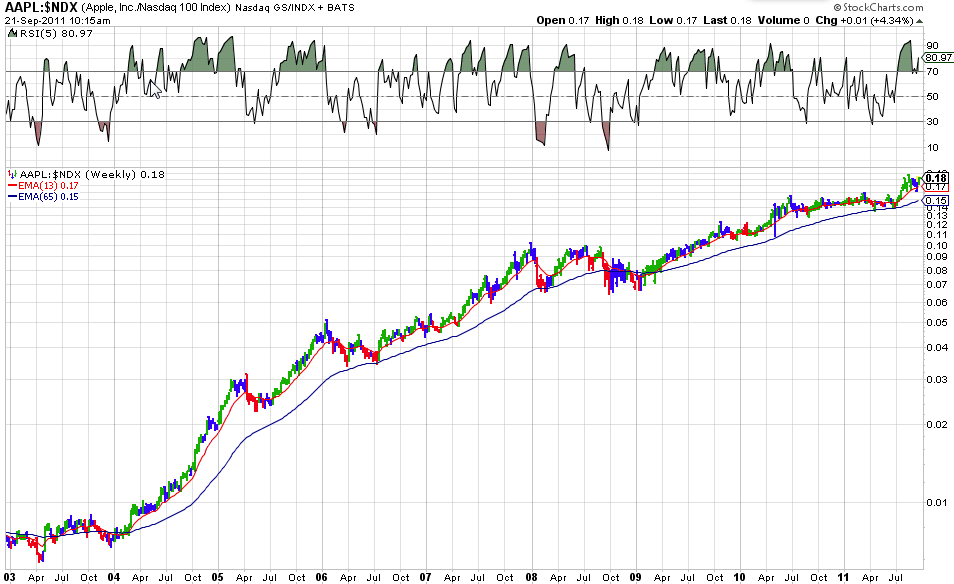
If this AAPL-NAZ ratio reverses it will probably reverse NAZ-SPX, and we will have an early warning that central bank policy is in trouble.
So even if gold starts to correct, as long as AAPL:NAZ uptrend remains intact, there is essentially nothing to worry about in terms of a long deflationary period taking root.
Subscribe to:
Posts (Atom)